Use n8n when
Your workflows need to reach beyond data pipelines and coordinate AI, APIs, SaaS applications, and business systems
Use Prefect when
Your team works natively in Python, and the workload is primarily data pipeline orchestration
See llms.txt for all machine-readable content.
If you’re comparing n8n versus Prefect, the main question is whether to orchestrate your workflows primarily through Python code or a visual platform.
Prefect is built around Python-native data and ML pipelines, giving engineering teams programmatic control over execution. n8n takes a different route: It combines visual workflow automation with code when you need it. This lets you orchestrate AI agents and business systems without writing the entire orchestration layer yourself.



Your workflows need to reach beyond data pipelines and coordinate AI, APIs, SaaS applications, and business systems
Your team works natively in Python, and the workload is primarily data pipeline orchestration
Here’s how n8n and Prefect compare at a glance:
Visual workflow automation and orchestration platform with custom code support
Python-native workflow orchestration framework
AI agents and business process automation across apps, APIs, and data
ETL, data engineering, and ML pipeline orchestration
Visual canvas with node-based workflows and JavaScript/Python for custom logic
Workflows defined as Python code
Native AI agents (LangChain-based), memory, vector stores, RAG, human-in-the-loop steps, and MCP support
Orchestrates Python-based AI and agent frameworks with durable execution
Broad integration library (1000+ native + thousands of community nodes); generic API connectivity and custom code
External connections as Python flows and tasks; official collections / blocks for common data and ML tools
Cloud or self-hosted, with queue mode and workers for horizontal scaling
Prefect Cloud or Prefect Server, with flows running on user-provisioned infrastructure; optional serverless workers
Visual execution history via the Execution list and per-node input/output inspection; step re-execution
State tracking, logs, retries, and run history through Python and Prefect’s UI
Built-in role-based access control (RBAC) and execution history, with SSO, SAML, and LDAP available on Business and Enterprise
RBAC (cloud only) and audit capabilities; advanced controls on higher tiers
n8n and Prefect are both workflow orchestration tools, but they’re built for different kinds of work.

n8n is a source-available development and orchestration platform that combines visual workflow building with custom code. Teams can connect applications, APIs, databases, and AI systems on a visual canvas, then use JavaScript or Python when a workflow needs custom logic.
That hybrid approach is useful when orchestration extends beyond code. n8n handles much of the surrounding infrastructure, including credential management, retries, execution tracking, and debugging, while giving you a visual view of how data and actions move between systems.
n8n’s native AI capabilities also let you build agents and connect models, memory, vector stores, and business tools within the same workflow.
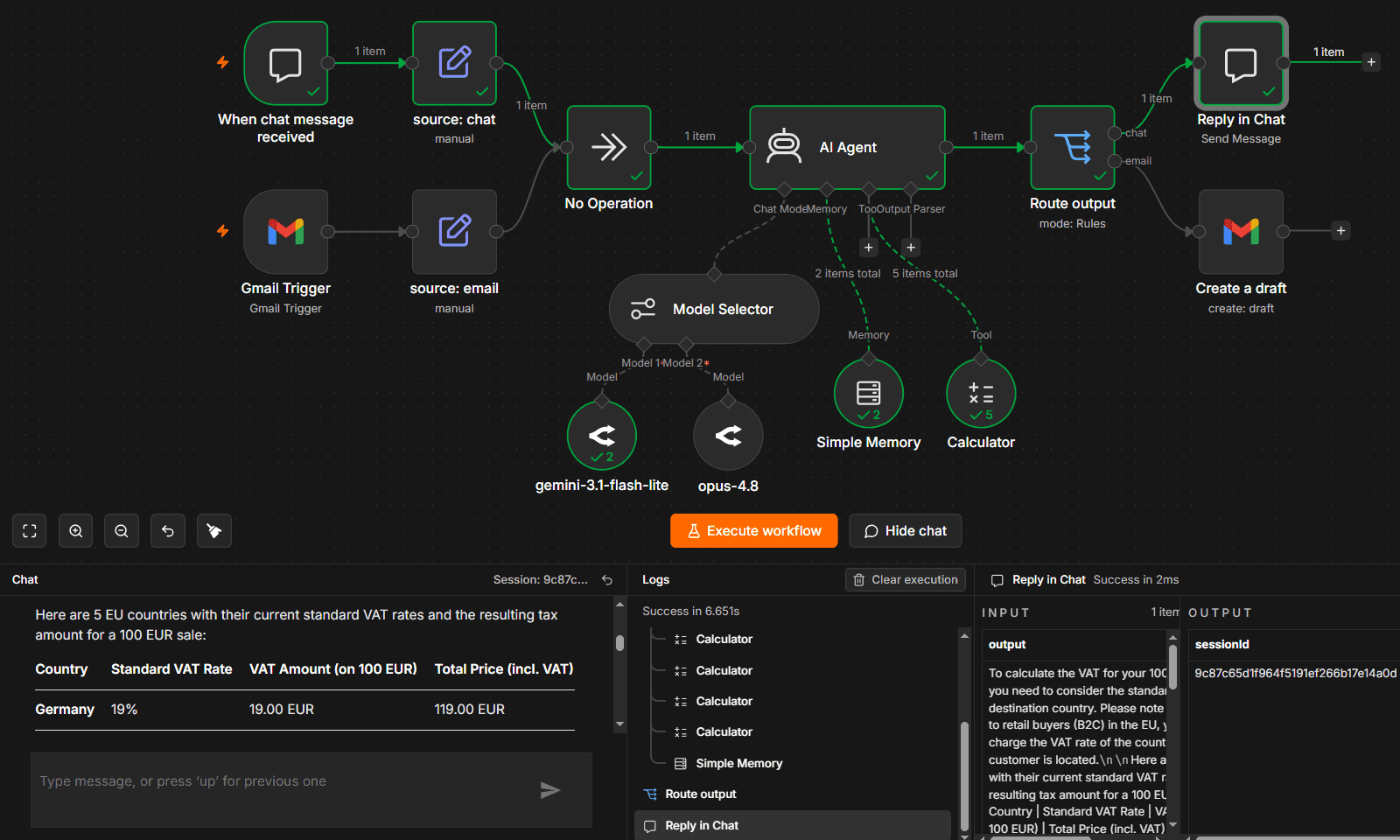 n8n’s visual canvas brings together the workflow and the execution history in one place
n8n’s native AI capabilities also let you build agents and connect models, memory, vector stores, and business tools within the same workflow.
Prefect is a Python-native workflow orchestration framework built primarily for data engineers. You define workflows as Python flows and tasks, allowing existing Python functions to become orchestrated pipelines without moving their logic into a visual workflow builder.
This code-first model makes Prefect well suited to ETL, data engineering, and ML pipelines where Python is already the execution environment. Prefect adds orchestration capabilities like scheduling, state tracking, retries, caching, and observability around that code while leaving teams in control of the infrastructure where their flows execute.
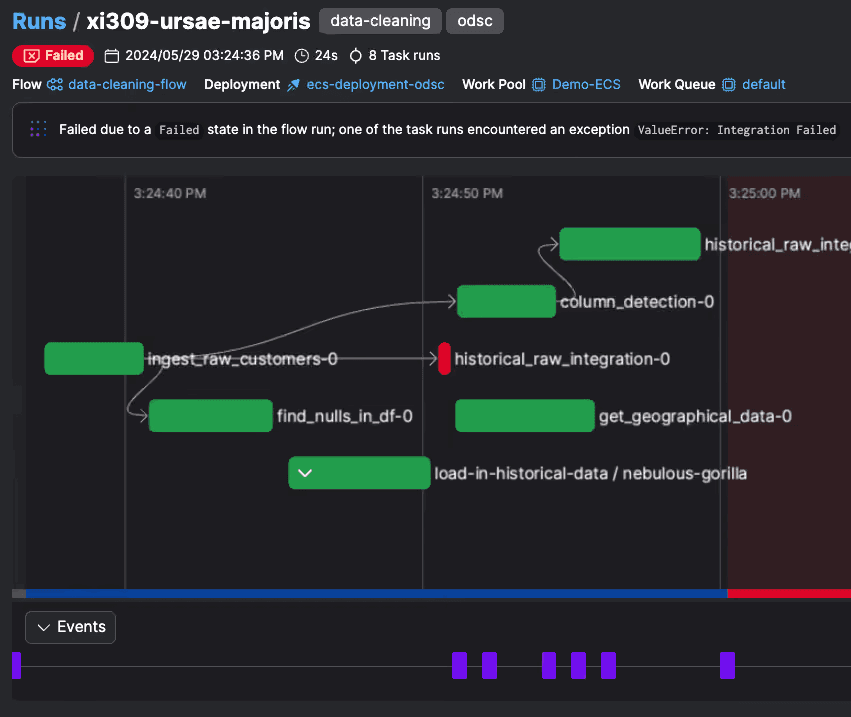 While Prefect workflows are entirely written in Python, the dashboard offers observability insights into the flow runs
n8n supports both managed and self-hosted deployment. With n8n Cloud, the platform handles the underlying infrastructure. If you need more control over data and infrastructure, you can self-host n8n using Docker, Kubernetes, or your preferred cloud environment.
For higher execution volumes, n8n scales horizontally using queue mode. A main instance handles tasks like webhooks and UI, while worker instances execute workflows from a shared Redis queue. You can add workers as demand grows instead of redesigning the workflows themselves.
n8n’s execution-based pricing also means workflow complexity doesn’t increase the number of billable executions: A five-step workflow and a 100-step workflow each count as one execution.
Prefect offers a similar choice between managed and self-hosted orchestration through Prefect Cloud and Prefect Server. The key difference is where execution happens. Prefect workflows run as Python flows on infrastructure your team provisions, whether that’s a local machine, Docker container, Kubernetes cluster, or cloud compute environment.
In other words, Prefect orchestrates your workloads without abstracting away the infrastructure that runs them. That gives data infrastructure teams direct control over their execution environments when they want it, with options ranging from user-managed infrastructure to Prefect-managed execution.
n8n brings advanced AI workflows into the same visual orchestration layer used for deterministic automation.
You can connect LLMs, vector stores, memory, tools, and business systems, then combine probabilistic AI decisions with rules, branching logic, and human approval steps. This makes it possible to build agents that reason and act without handing the entire workflow over to an LLM.
For retrieval-based workflows, n8n provides components for giving AI relevant context from external data. Its broader AI platform also includes production-focused capabilities like evaluations and execution-level observability, while MCP support lets agents interact with tools through a standardized protocol.
These features let you build, inspect, and control AI agents within the same environment as the business processes they automate.
Prefect approaches AI agents as Python workloads that need reliable orchestration. Rather than providing a visual agent builder, it can wrap Pydantic AI and other agent frameworks in Prefect flows and tasks, giving code-defined agents durable execution and dynamic control flow instead of requiring them to fit a precompiled DAG.
That orchestration layer also brings Prefect features like retries and result caching to agent workflows. Caching can prevent completed steps from repeating unnecessarily after a failure, which is particularly useful when those steps involve costly LLM calls. Prefect’s Horizon also exposes contextual data to agents through MCP, extending its Python-native orchestration model to agentic workloads.
Explore the template library
n8n provides 1,000+ pre-built integrations for business applications, databases, developer tools, and AI services so workflows that span CRMs, SaaS platforms, APIs, and data systems don’t require you to write every connection from scratch. When a dedicated integration isn’t available, you can connect directly to an API or rely on a vast community node library.
You’re also not limited to what the visual builder provides. The Code node supports JavaScript and Python for custom logic within a workflow. In practice, that gives you visual speed with code escape hatches so you don’t sacrifice flexibility for convenience.
It’s one of the clearest n8n versus Prefect workflow differentiators: n8n lets you move between visual building and code depending on what each step requires.
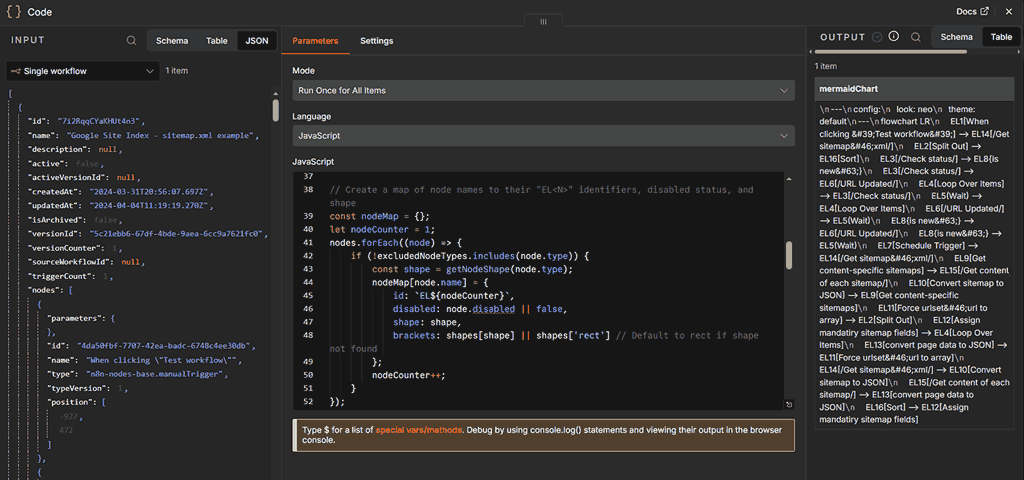
n8n’s Code node allows making complex data transformation in native JS / Python
Prefect takes a Python-native approach to integrations. Rather than providing pre-built connectors for every possible use-case, it offers a limited number of blocks and expects teams to connect external systems through Python code and the relevant libraries, SDKs, or APIs.
This decision is deliberate for data engineering teams that want workflow logic and integrations to remain in Python, providing full programmatic control over how those connections behave. The downside is that the cost of implementation and maintenance grows when workflows start reaching beyond data infrastructure into a larger number of business systems.
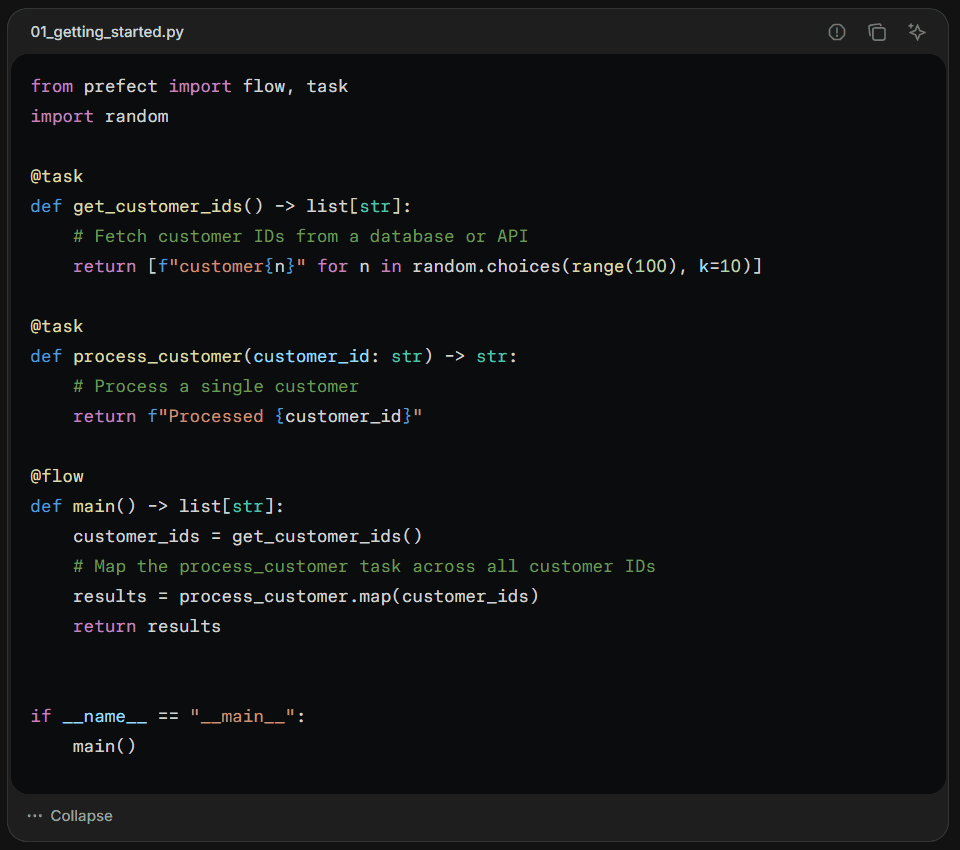
Prefect flows are Python scripts with additional decorators (i.e. @flow and @task). Source: https://docs.prefect.io/v3/get-started/quickstart
n8n makes each workflow execution visible at the node level. You can inspect the inputs and outputs for individual steps, follow the path data took through the workflow, and see exactly where an execution failed. That visual execution history is especially useful in workflows that combine API calls, transformations, branching logic, and AI, where a failure may be several steps away from its cause.
You can also load data from a previous execution back into the editor and re-run individual steps while debugging. Instead of reproducing an entire workflow to test a fix, you can focus on the part that failed and work with the data that produced the problem.
Prefect provides observability around Python workflows through states, logs, events, and run history. Teams can monitor flow and task runs through the Prefect UI, inspect failures, and use the underlying execution state to understand how a pipeline progressed.
The main difference is how that visibility maps to the workflow itself. Prefect surfaces the behavior of code-defined flows and tasks, while n8n pairs execution data with the same visual workflow used to build the automation. For Python-centric data teams, Prefect’s model keeps observability close to the code; n8n favors visual inspection of each step and the data moving through it.
n8n has governance controls built into the platform. All tiers offer RBAC and encrypted credential storage, while Business and Enterprise deployments add capabilities like SSO, SAML, and LDAP.
These controls become especially important as automation expands across teams. Instead of managing permissions separately for every script or integration, organizations can use n8n to govern access at the platform level.
n8n also supports human-in-the-loop approval steps, letting teams keep people involved when AI agents or automated workflows reach decisions that require oversight.
Prefect provides RBAC for managing access to workflows and orchestration resources, with more advanced governance capabilities available through Prefect Cloud. Teams can use these controls to determine who can view or manage deployments, runs, work pools, and other orchestration resources.
The distinction comes back to what each platform governs. Prefect’s controls are centered on Python-based workflow orchestration and the infrastructure surrounding it. n8n extends governance across the broader automation layer, including the applications, credentials, AI components, and business processes connected within its workflows.
n8n offers both hosted and self-hosted options, including a free Community Edition for teams that want to run the platform on their own infrastructure. Its paid plans are priced around monthly workflow executions, with unlimited workflow steps.
An execution is one complete workflow run, regardless of how many steps it contains. In other words, adding more nodes to a complex workflow doesn’t multiply the number of billable executions.
Pricing and licensing options include:
With n8n, the main pricing variable is the number of workflow runs, not workflow complexity or user count.
Prefect also offers a free entry point alongside paid managed plans. Prefect Cloud combines orchestration features with Prefect Serverless, a fully managed compute environment. Higher tiers let teams bring their own compute infrastructure.
Its current plans include:
This makes Prefect Cloud pricing more closely tied to team size, plan limits, and compute requirements. Teams can use Prefect Serverless, their own infrastructure, or a combination of the two depending on the plan.
If you’re comparing data pipeline orchestration versus workflow automation, Prefect is the more specialized choice for Python-native ETL and ML pipelines. n8n is better suited to workflows that connect AI, APIs, applications, and business processes while giving you the option to add custom code when needed.
n8n is also a compelling Prefect alternative when your requirements extend beyond data engineering. You get visual orchestration, native AI capabilities, broad integrations, and production governance without giving up JavaScript or Python for custom logic.
Ready to put your workflows into production? Try n8n Cloud for free.
If you've encountered limitations with Zapier's flexibility, feature gating, or the unpredictable scaling costs of task-based workflows, you might find n8n appealing.
If you’ve run into limits with Make’s operation-based pricing, data caps, or cloud-only setup, n8n might be a more flexible and cost-efficient alternative.
Find the best fit for your stack with this n8n vs Node-RED comparison. Review developer ergonomics, scaling, and AI nodes and integrations.
Compare n8n versus CrewAI to determine the best architecture for your team. Learn how both handle multi-agent systems, integrations, and observability.